Silversun Pickups
FollowLos Angeles, CA
About
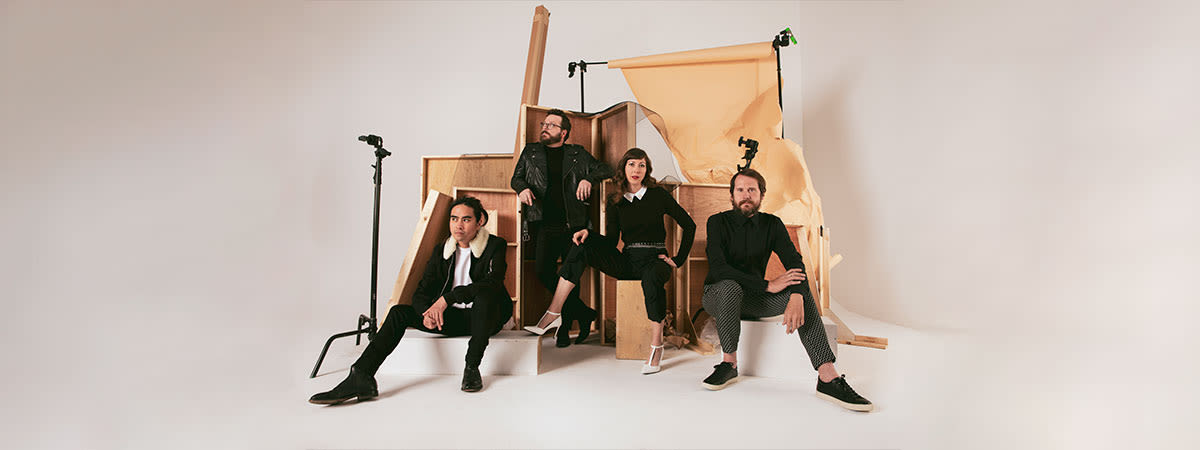
Brian Aubert (guitar, vocals) * Nikki Monninger (bass)
Joe Lester (keyboards) * Christopher Guanlao (drums)
Silversun Pickups have always considered their sonic density a source of
pride: The Los Angeles band’s four studio full-lengths—including their 2006
gold-selling debut, Carnavas,which spawned the hits “Lazy Eye” and
“Well Thought Out Twinkles”—reveal additional sonic gifts with each
subsequent spin.
Their fifth album, Widow’s Weeds, also caters to an adventurous,
patient group of listeners. Strident acoustic strumming tussles with raging
electric riffs, as urgent, precise beats and moody electronic pulses
percolate underneath. The band members—which, in addition to Aubert,
include bassist Nikki Monninger, drummer Christopher Guanlao and
keyboardist Joe Lester—were also in agreement with the album’s starting
point (the urgent synth-rocker “Neon Wound”) and closer (the aggressive,
throttling “We Are Chameleons”). The band admitted that everything in
between, including how the rest of Widow’s Weeds was sequenced and
how the album unfolded, often surprised the band.
“We didn’t know exactly which emotional level the lyrics were going to
start at,” Aubert says. “I was like, ‘Are they going to be angry, with
these crazy times?’ Everything seems so polarized and bizarre and scary.
All of these things affect you. And then as they were coming out, it was
like, ‘No, they sound like they’re kind of mourning.’ I couldn’t quite put
them all together.”
To make sense of these ideas, Silversun Pickups enlisted a long-time
friend: producer Butch Vig (Nirvana, Smashing Pumpkins, Sonic Youth).
Incredibly enough, this was the first time the band had worked with Vig,
even though the idea of collaborating had been floated for years. The
timing didn’t feel right until now, Aubert says. “With the ideas that were
popping around in my head, it felt like, ‘God, this would be awesome; I
think it’s time. If Butch is interested in doing this at all, let’s just
call him.'”
Vig and mixer Billy Bush helped Silversun Pickups craft a confident,
extroverted album in which every instrument is clearly audible in the mix.
Pulsing, Cure-like keyboards hold their own against slashing riffs on “Neon
Wound”; antique-sounding violin and cello enhance fragile acoustic
strumming on “Straw Man”; and the spring-loaded, glammy “It Doesn’t Matter
Why” boasts pogoing beats and needling pizzicato plucks. The album’s more
restrained moments also maintain this crispness. “Simpatico” is “the
closest we’ll get to a James Bond song,” says Aubert, who immersed himself
in movie scores as the album was coalescing. Widow’s Weedsstrikes
a perfect balance between provocative noise and distortion, and lush,
introspective pop tranquility.
The band members also decided not to go overboard layering on instruments
and sounds, which contributed to the album’s clearer approach. “We made a
conscious effort to rein in the electronic stuff a little bit, and have
more pianos and organs,” Lester says. “There’s still synthy stuff on there
for sure. But we have strings again, which we hadn’t done for a couple of
records. And there’s a lot less sequenced electronics. It was like, ‘Let’s
strip the palette a little bit, and see what happens.’ And that goes back
to the directness of things.”
Vig’s versatility and songwriting background helped the band shape other
songs—including and especially “Don’t Know Yet,” on which glitchy, taut
electronic textures segue into explosive choruses drive by brusque drums
and noisy guitars. “It has moments of intimacy, but then it really comes
alive and big-sounding,” Guanlao says of the song. “That’s all Butch. We
would have probably gone a totally different direction if it wasn’t for him
hearing that this once-intimate, mellow song can be really boastful and
rocking.”
In the end, recording with Vig surpassed the band members’ already-high
expectations. “He really listens to each band member, and he puts a great
value on each individual, and what they can add to the music,” Monninger
says. “It was very collaborative with him. He’s such an easygoing person,
and he put everybody at ease.” That camaraderie translated into a studio
environment that involved intense and serious hard work unfolding in a
jovial, even lighthearted, manner. “We had a really fun time recording this
album,” Guanlao says. “He really did get the best out of us. We didn’t want
it to end.”
Despite the halcyon studio time, the band members were wrestling with
challenges in their personal lives. The album had to be done in two
separate blocks of time, since Vig had Garbage tour plans already on the
calendar, which left Silversun Pickups with a break between sessions.
During that gap in time, Lester’s father passed away. Aubert, meanwhile,
found himself in an extremely dark place, for reasons he couldn’t
immediately explain.
“We started making this album about mourning, and it’s like, ‘What are you
mourning? Are you really mourning politics and stuff like that? Or what is
happening?’ I didn’t realize that I was finding myself in this space where
I completely tried to take on everything myself. I couldn’t ask for help; I
couldn’t let anybody in. That led me to start drinking in a different way,
that I never did before.”
As a result, Aubert—who was already feeling “emotionally closed off,” as he
puts it—fell into a deep depression. “I didn’t know how to get out of it,”
Aubert says. “Finally, I was just like, something big has to happen.” His
solution was getting treatment and getting sober during the gap between
recording sessions—a decision that immediately improved his mental health
and creative outlook.
Unsurprisingly, Aubert also had a much different perspective on his Widow’s Weeds lyrics post-treatment, and understood more what
messages he was trying to convey with the album. “The record does have a
mourning vibe, but it’s not sad,” he says. “It’s change. It’s growing up,
and moving on and letting go of things. And it’s okay to be sad about those
things, and mourn them. It’s actually healthy to do so, and take the time
to do it. At the end of the day, it’s going to be much better and much more
fulfilling when you get through it.”
“When I got sober, and took a little time to myself to move as a human, we
came back at the record again,” Aubert says. “Then it was like, now we’re
back into the record, and writing again. It was wild. Things are
really changing, and I’m starting to emotionally connect to things, and
starting to take care of myself. I’m starting to ask for help.”
Aubert’s bandmates also saw an immediate change in him as they reconvened
to finish Widow’s Weeds. Guanlao noticed that the vocalist was
opening up to him and the rest of the band more, and allowing himself to be
more vulnerable, while Monninger observed increased clarity. “I’m really
proud of him for coming through all this. He focused so much on the album
and put so much of his heart into it—as we all did, but especially coming
out of all that, he needed something to really focus on.” Lester also saw
big, positive differences in his bandmate. “It was like, ‘okay, this has
actually been really good; he’s gotten stuff that has probably been
bothering him for a long time sorted out.’”
In a nod to Aubert’s healthier mindset—and in a big change from past
working environments—the members of Silversun Pickups welcomed friends and
family into the studio as they were recording. “This was the first album
where we were open,” Aubert says. “Not just with Butch, but with people
around us. We played stuff for people. We never used to before. We’d play a
little mixing and things like that. We were too shy.” Creating this kind of
social, nurturing atmosphere added levity and accountability, and kept
everyone in the band grounded. “Doing this in front of people is so much
more enlightening, and really helps you focus on things,” Aubert says. “We
were exposed. I see how that can be scary to people, but for us we really
thrived on that.”
Widow’s Weeds
ends up being about rebirth and renewal, facing darker elements of the soul
(or society) head-on, and choosing to either engage—or leave them behind.
This shift toward blunt candor wasn’t lost on Lester. “I feel Brian’s
lyrics have gotten more direct over the last couple of records. He’s much
more open and less coy about what he’s singing about. There’s less trying
to put Vaseline on the lens.”
Over the years, Silversun Pickups have racked up 210 million worldwide
streams and 10 Top 20 hits on Billboard‘s Alternative Songs chart,
led by 2009’s ferocious chart-topper “Panic Switch.” Nearly 20 years after
the band formed, it’s not lost on Monninger that they’re one of the few
groups they’ve grown up with who have sustained a career. “I don’t know
many bands that have lasted that long,” she says. “But we started as
friends first, and we care about each other—you know, this is our second
family. We really believe in what we’re doing. We’re going to take it as
far as we can.”
For Aubert, moving forward involves staying connected to his own self (and
remembering to prioritize self-care) and being attuned to creative impulses
when they arise. If that means going outside of his comfort zone, so be it.
“This album feels the most naked out of all of them,” Aubert says. “That’s
scary at first. But that goes into my whole headspace. That goes into how
things went down. It was like, ‘Hey man, you were so unaware of the things
you needed, and so closed off. Just do it. Stop hiding. It was crushing
you. Don’t be afraid.’