About
In 1869, after several years of lobbying by prominent south-siders,
the Illinois State Legislature established the South Park Commission.
The newly appointed Board of Commissioners identified more than 1,000
acres of land just south of Chicago for a large park and boulevards that
would connect it with downtown and the West Park System. Originally
called South Park, the property was composed of eastern and western
divisions, now Jackson and Washington Parks and the Midway Plaisance.
The commissioners hired Frederick Law Olmsted, the "father of American
landscape architecture," and his partner Calvert Vaux to create the
original plan for South Park.
Olmsted and Vaux published their
ambitious plan in 1871. The destruction of tax rolls and other documents
in Chicago's Great Fire that year delayed construction. In 1872, the
South Park Commission hired Horace W. S. Cleveland, who had previously
worked for Olmsted, to oversee improvements to the park. Construction
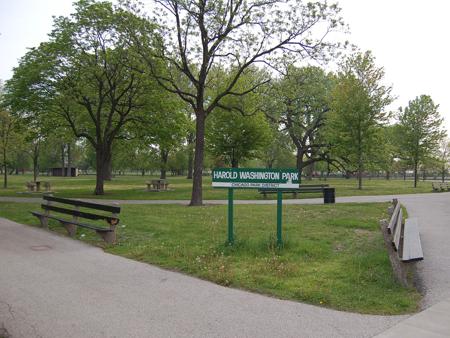
began on the western division, which was renamed in 1881 to honor George
Washington (1732-1799), first president of the United States. One of
the earliest improvements was the "South Open Green," a pastoral meadow
with grazing sheep, also used as a ball field. Architect Daniel H.
Burnham's firm designed several buildings in the park. These include the
1880 limestone round stables, the 1881 refectory, and the 1910
administrative headquarters for the South Park Commission. Today, the
administrative building houses DuSable Museum of African-American
History.